Humanity

If neither the Bible nor God has a “violence”—problem…then that leaves only one culprit…
It is telling that just after the myth of the garden, the Hebrew scriptures recount the mythical story of one human being, Cain, in a fit of jealousy, murdering another human being, his brother, Abel. The object of jealousy in this story is God. Cain was jealous because, according to the story, God preferred Abel’s offering over and above Cain’s offering. Cain was jealous for God’s approval, affection and attention, and he saw Abel as his rival. So Cain invited his brother for a walk in the field. There “Cain attacked his brother Abel and killed him.” When confronted by God about Abel’s whereabouts Cain answered, “I don’t know! Am I my brother’s guardian?”[1] [the answer being “Yes!”]. As a result of his violence, Cain was sent away East of Eden. There, as the myth goes, Cain married a woman. They had a son. And Cain built a city. Hence human civilization comes about as a result of the “first murder”.
Like the mythical Cain, humanity still uses violence expecting it to solve its problems. But, it never does. Never! In the short term it may quell the conflict or appear to solve the problem. But in its wake are left unintended victims, a new corps of trauma-fueled enemies, and the conflict or problem still smoldering under the surface bound to explode again at an opportune time.
Religious humanity is not immune to the idolatry of violence. Many a religious devotee or nation, from Constantine to the Crusaders, to so-called “Christian” Nationalists has co-opted parts of scripture and its descriptions of the god of “righteous” violence. The misunderstanding of God as an almighty god, whose wrath burns hot against sinners and any who oppose god, has informed and justified violent behavior from humanity’s beginnings.
Yes, humanity is the culprit…Humanity has a violence problem.
We have grasped the mystery of the atom and rejected the Sermon on the Mount…Ours is a world of nuclear giants and ethical infants. We know more about war than we know about peace, more about killing than we know about living. — General Omar Bradley [2]
Maybe it is well past time we, humanity, try something radically different than violence.
_______________________________________________________________
[1] Genesis 4:8-9 (NET)
[2] Omar Bradley, Armistice Day Address in Boston on November 10, 1948. From The Collected Writings of General Omar N. Bradley, vol. 1 (U.S. Government Printing: 1967), 588-589.
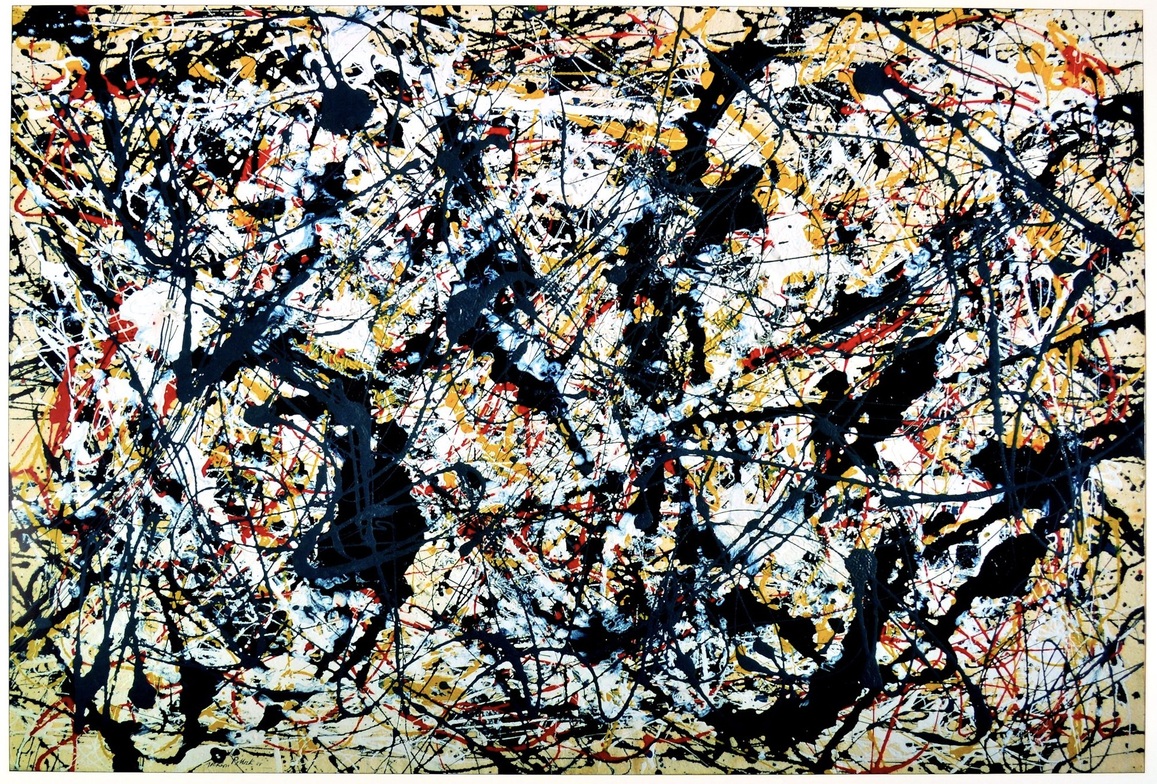
Photo Jackson Pollock "Silver over Black, White, Yellow and Red" 1948
-
Location