Pater Noster

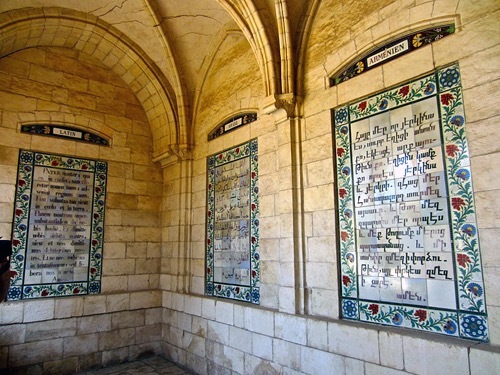
As I wrote on Saturday, the Lord’s Prayer, or Our Father, is recorded only in the Gospel accounts of Matthew and of Luke.
Here’s how the prayer is recorded in Matthew:
Pray, then, in this way:
Our Father in heaven, may your name be revered as holy.
May your kingdom come. May your will be done
on earth as it is in heaven.
Give us today our daily bread.
And forgive us our debts, as we also have forgiven our debtors.
And do not bring us to the time of trial,
but rescue us from the evil one.
Luke’s version is quite similar:
When you pray, say:
Father, may your name be revered as holy.
May your kingdom come.
Give us each day our daily bread.
And forgive us our sins,
for we ourselves forgive everyone indebted to us.
And do not bring us to the time of trial.
Not identical, but similar. Not containing all of what we pray today, but the essentials.
During Lent of 2023, Pauline and I had the privilege of visiting the Holy Lands. One of our many stops along the way was the Pater Noster Church on the Mount of Olives just east of the Old City of Jerusalem. Tradition from before the 300s C.E. suggests this site to be the location where Jesus taught his disciples the Lord’s Prayer—the “Our Father” — which in Latin is Pater Noster, thereby the church’s name.
Whether this was the actual site matters not. For over 1700 years the faithful have come to this church in this place to give thanks for the Lord’s Prayer and to pray that prayer in all the various languages of the earth. Today, the church’s courtyard walls are adorned with ceramic plaques displaying the Lord’s Prayer in over 100 languages. Everything from English to Greek, Chinese and Cherokee, Hebrew and Arabic. The Pater Noster church stands as a visible sign of the Lord’s Prayer’s significance to the church and to its global appeal.
The Our Father is a part of the roots of faith of the early church. Its use inspired the evangelists Matthew and Luke to include it in their gospel accounts. Long before we ever prayed this prayer in King James English, it was prayed in Aramaic, Greek, Arabic, Latin and so on down through time. For nearly 2000 years, the Lord’s Prayer has been prayed by the faithful, in many languages, with one voice, uniting us and rooting us in faith.
P.S. Please do yourself the favor of watching and listening to Sufian, our tour guide, a Palestinian Christian, as he sings a portion of the Lord’s Prayer in Arabic, one of the prayer’s original languages. Click below. You’ll be glad you did.
-
Location