Transform

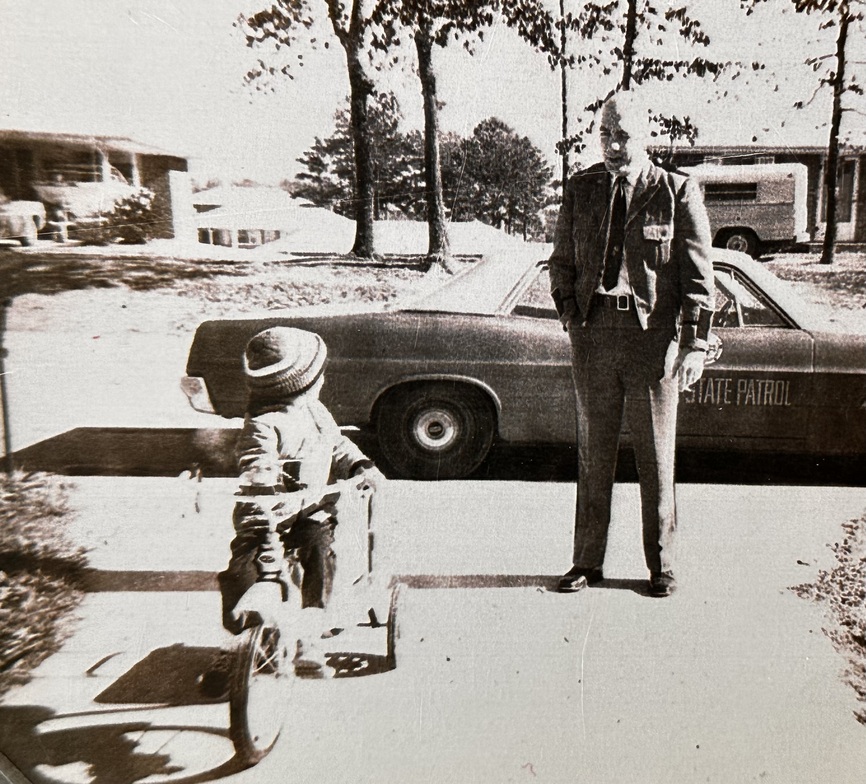
It’s hard to believe it’s been 22 years since my father died. As with many fathers and sons, our relationship was…complicated. (I won’t get into all of that in this format.) Suffice it to say, as a very young child I believed my father could do no wrong. In my young eyes he was the tallest, the strongest, the smartest man in the world. At that tender age, I wanted to grow up to be like him. Then I became a teenager. Looking through teenage eyes, my father seemed less “perfect”. In those un-evolved teenage years I could only see his faults and failings. (I could not see my own mind you, just his.) Fortunately I didn’t remain a teenager. Slowly, and in fits and starts, I began to mature and to realize my father and I — we were on the same journey, a journey of redemption, of transformation.
The truth is, we all are on that same journey, aren’t we?
In yesterday’s devotion, I wondered, “What does it mean to be redeemed? What is redemption, exactly?” Today I’d like to suggest that a way of understanding “redemption” is to mean transformation.
Transformation doesn’t happen in just a one-time baptism down at the river. Transformation is a lifelong movement of conversion that happens slowly and in fits and starts. As the Franciscan author Father Richard Rohr states …
…transformation…more often happens not when something new begins but when something old falls apart. The pain of something old falling apart—chaos—invites the soul to listen at a deeper level. It invites and sometimes forces the soul to go to a new place because the old place is falling apart…That, of course, is why real transformation is so difficult, because it comes with a cost. It requires death followed by resurrection. That’s the universal pattern.[1]
Usually we will do everything we can, everything in our power, to avoid death. We’d rather stew in the pain we know than experience the pain of changing. As long as we perceive that pain, the pain of changing to be greater than our current pain, we will not change.
Listen as Richard Rohr continues:
Spirituality is always eventually about what you do with your pain. I believe the message of the crucified Jesus is a statement about what to do with your pain. It’s primarily a message of transformation, and not a transaction to “open the gates of heaven.” For some unfortunate reason Christians have usually “used” Jesus as a mere problem solver, one who would keep us personally from pain later.
The big loss was…that we missed Jesus’ message of how to let God transform us and our world here and now. [2]
[1] Richard Rohr, Transformation: Week 1, Change as a Catalyst for Transformation, Thursday, June 30, 2016, Daily Meditations, Center for Action and Contemplation, cac.org
[2] Richard Rohr, Transformation: Week 2, Transforming Our Pain. Sunday, July 3, 2016, Daily Meditations, Center for Action and Contemplation, cac.org
Photo from Eric Murray
-
Location